
 Gemotion screen shows video in living 3D
Here’s a groovy display for people looking to add that extra dimension to their viewing material…
Gemotion is a soft, ‘living’ display that bulges and collapses in sync with the graphics on the screen, creating visuals that literally pop out at the viewer.
Yoichiro Kawaguchi, a well-known computer graphics artist and University of Tokyo professor, created Gemotion by arranging 72 air cylinders behind a flexible, 100 x 60 cm (39 x 24 inch) screen. As video is projected onto the screen, image data is relayed to the cylinders, which then push and pull on the screen accordingly.
“If used with games, TV or cinema, the screen could give images an element of power never seen before. It could lead to completely new forms of media,” says Kawaguchi.
The Gemotion screen will be on display from January 21 to February 4 as part of a media art exhibit (called Nihon no hyogen-ryoku) at National Art Center, Tokyo, which recently opened in Roppongi.
[Source: Asahi]

Sayaka: Next-generation capsule endoscope
Endoscopic capsules, ingestible pill-shaped devices designed to capture images from inside the digestive tract, have been around for quite a while. But Sayaka, an endoscopic capsule developed by RF System Lab in December 2005, has dramatically increased the overall image quality by changing the camera position and enabling the camera to rotate.
While conventional capsules — including RF System Lab’s own Norika — typically have cameras at one end of the capsule, Sayaka’s camera has been moved to the side, where it has a better view of the intestinal walls. In addition, a tiny stepper motor rotates the camera as the capsule passes through the digestive tract, allowing Sayaka to capture images from every angle.
Like Norika, Sayaka’s power is supplied wirelessly from an external source, primarily so that no harmful battery substances get into the body.
On a typical 8-hour, 8-meter (26 feet) journey through the gastrointestinal tract, Sayaka snaps approximately 870,000 photos, which are sent to a receiver located near the body. Image mosaicking technology is then used to stitch the images together into a flat, high-resolution rectangular map of the intestines, which can be magnified up to 75 times. In addition to scouring the maps for problem areas, gastroenterologists can compare maps from previous sessions to track changes in a patient’s condition.
And as if all that were not enough, RF System Lab has released a trippy Sayaka promo video featuring a smooth disco/house soundtrack and starring a naked humanoid that floats over the Nazca Lines, shooting beams from its eyes as it scans the landscape below. Cool.
Video:
Giant street stationary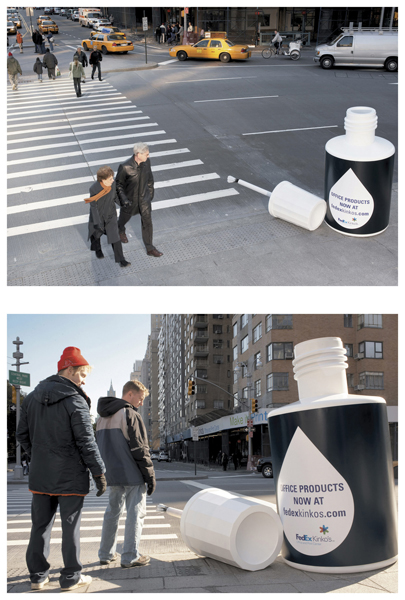
Just in case you'd forgotten about work and all the substance sniffing that goes along with getting through your day, some clever 'back to school retailer' has gone and strategically positioned giant Tippex bottles around NYC to make sure people don't forget about the grindstone for too long.
We haven't seen one of those bottles in years - thought that's what the backspace button was for.



Vertigo is flueless fire you hang on wall
For the outrageous price of $2500 you can get the Vertigo flueless fireplace that hangs on your wall. And unlike similar decorations this is an actual burning fire that runs on natural gas. So you'll still have a way to stay warm once they turn off your heat because you spent all your utilities money on this thing.
Cardboard Punch-Out Chairs
We have featured a number of challenging designs constructed entirely from singular materials. From cardboard sculptures of cars through to this latest design made entirely from light wood.
This 'punch-out' design stool comes complete with its own hang sell. Easier than a three year old's jigsaw puzzle, the pieces pop out of the frame to create a simple yet stylish stool.
If you know of any other simple punch-out designs or cool cardboard creations, let us know and we will feature them in upcoming posts!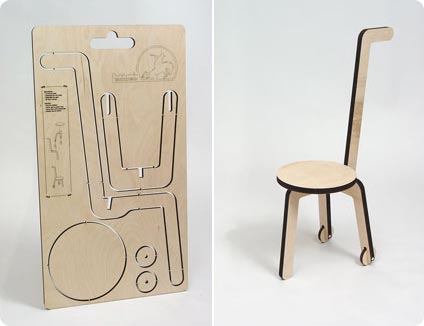
Wood Jeep - Wood chopper

Arist Lee Stoetzel made these beautiful huge wood vehicles from Pecky Cypress... [via] - Link.
Aimulet LA: award-winning eco design
The 2006 Good Design Award for Ecology Design goes to Aimulet LA, a batteryless, light-activated handheld audio communication device with an outer shell made from molded bamboo. The environmentally friendly communication terminal was designed by the Information Technology Research Institute at Japan’s National Institute of Advanced Industrial Science and Technology (AIST).
The name “Aimulet” is derived from the word “amulet” plus the letter “i,” which denotes “intelligent,” “interactive” and “infrared,” as well as “ai” (which means “love” in Japanese and refers to Aichi prefecture, the location of the 2005 World Expo). The initials “LA” stand for none other than Laurie Anderson, whose Walk Project installation for the 2005 World Expo featured the Aimulet LA. Visitors to the installation used the device to receive audio messages as they wandered the site.
Aimulet LA is designed to be held up to your ear like a cellphone. When you stand over special LED emitters set into the ground, Aimulet LA receives the light signals via an array of spherical micro solar cells (called Sphelar by manufacturer Kyosemi) set into the bottom of the handset. Aimulet LA translates the signals into audio messages that are transmitted through a tiny speaker in the device. In Laurie Anderson’s installation, visitors used Aimulet LA to listen to poems in four different languages as they strolled through a Japanese-style garden.
According to AIST, the technology at work in Aimulet LA can be put to use in public spaces such as outdoor exhibits and events, amusement facilities, train stations and parks, where it can be used in interactive media or entertainment. In addition, the low cost of the device means it could also double as an entrance ticket, annual pass or ID card.
The Good Design Award judges gave high marks to Aimulet LA’s design concept for its ingenious blend of new technology and natural materials. The device also earned points for its lack of external power source, a factor that contributes to the creation of a battery-free environment. Being light-activated also makes it highly versatile, and its use of bamboo makes it easily recyclable and environmentally friendly.
This award marks the first time for AIST to receive a Good Design Award in Ecology Design. AIST previously received a Good Design Award for Paro, the cuddly seal robot recognized by the Guinness Book of World Records as the world’s most therapeutic robot.
Check out the Good Design Award page for more amazing designs.
[Source: AIST press release, AIST paper (English, pdf format)]


