
Pikasso
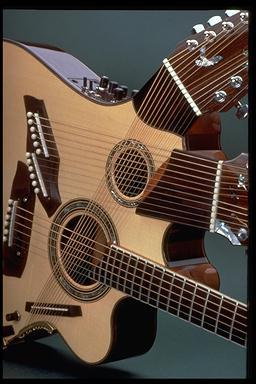
Four necks. Two sound holes. 42 strings. Two access doors; one on the upper player's side and one at the tail block.Created by luthier Linda Manzer for guitarist Pat Metheny, the instrument took 2 years to build (approximately 1000 hours), and when the 42 strings are strung up to high tension, the Pikasso is under approximately 1000 lbs pressure. It weighs 6.7 kg or 14 3/4 lbs. The body is tapered so that the side closest to the player is thinner than the side that rests on the players knee, thus leaning the top back towards the player for a more aerial view. This is also more comfortable under the player's arm.
The instrument is outfitted with a complete state of the art piezo pickup system. (Designed and installed by Mark Herbert, Boston) This included a hexaphonic pickup on the 6 string section that allowed Metheny to access his Syclavier computer system thus triggering any sound including sampled sounds. Two mounting holes on the treble side (knee side) so that the guitar can be mounted on internal brass insets attaching to a stand, leaving hands free for playing or viewing.
Visit Linda Manzer's website at http://www.manzer.com/ for more information on her quality custom guitars.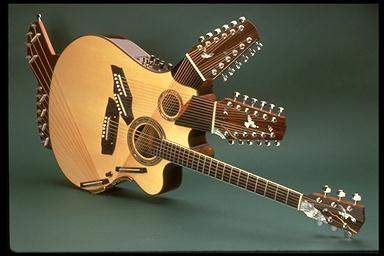

ECO YAMAHA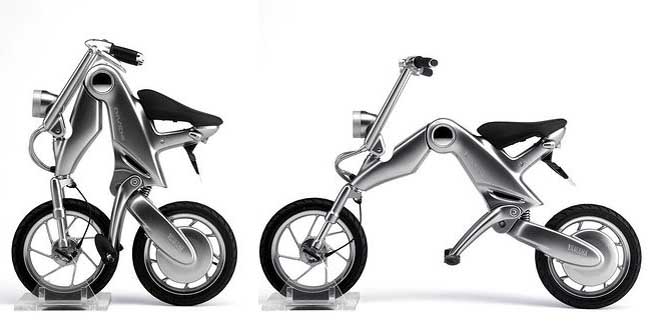
(Click on thumbnail for larger view)
Finding smart ways to get around is an ongoing quest. First there was the humble scooter, which had a cult-like following among inner-city execs in 2001. Coming up next is the Yamaha Divide, an electric commuter bike that folds up at the touch of a button to become more sculpture than scotter, more modern art than motorbike. Powered by a compact "smart power" electric motor, the Divide- which is still at concept stage (Yamaha hopes to put into production next year) - uses no petrol or oil so it can be stored inside where friends can view the "new art".
by Billy T
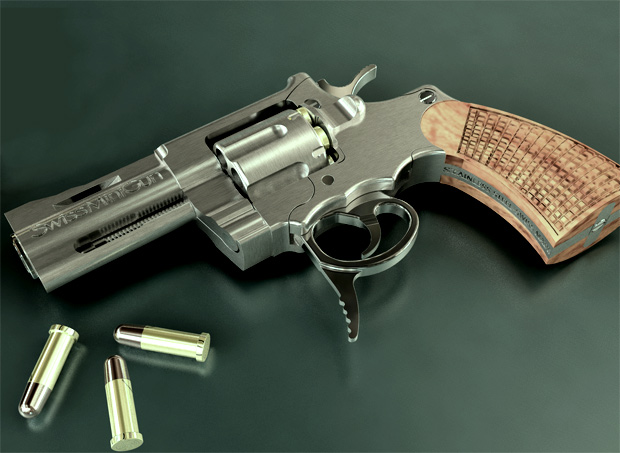
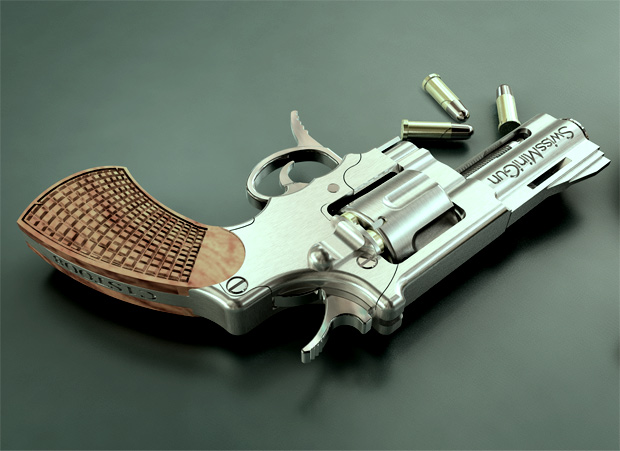
SwissMiniGun is proud to present the smallest revolver and ammunition in the world.
It's total length does not exceed 5.5 cm.
It shoots 2.34 m/m rim-fire ammunition.
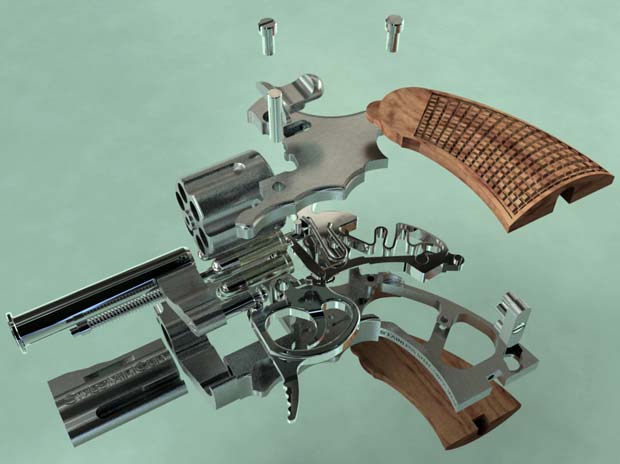
This firearm is a scaled-down model of the much acclaimed and mystical Colt Python with all the same features as are found on the real size gun.
The manufacture of this exceptional miniature revolver has only been possible by exploiting the incomparable expertise and latest technologies of the Swiss Watch and Jewellery Industry, upon which its Worldwide reputation is built.Our revolver and it's ammunition are 100% Swiss Made.SwissMiniGun is a fully authorized and licenced gunsmith company in Switzerland.
Article and Pics Come [VIA]






Device uses waves to “print” on water surface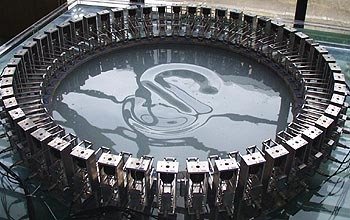
Researchers at Akishima Laboratories (Mitsui Zosen), working in conjunction with professor Shigeru Naito of Osaka University, have developed a device that uses waves to draw text and pictures on the surface of water.
The device, called AMOEBA (Advanced Multiple Organized Experimental Basin), consists of 50 water wave generators encircling a cylindrical tank 1.6 meters in diameter and 30 cm deep (about the size of a backyard kiddie pool). The wave generators move up and down in controlled motions to simultaneously produce a number of cylindrical waves that act as pixels. The pixels, which measure 10 cm in diameter and 4 cm in height, are combined to form lines and shapes. AMOEBA is capable of spelling out the entire roman alphabet, as well as some simple kanji characters. Each letter or picture remains on the water surface only for a moment, but they can be produced in succession on the surface every 3 seconds.
Researchers at Akishima Laboratories have developed similar devices in the past that used waves to draw pictures on the surface of water, but those devices had trouble producing letters with straight lines (such as the letter K). Additionally, it took the previous devices up to 15 minutes of data input time to produce each letter.
The newly developed technology uses improved calculation methods for controlling the wave generators, relying on formulas known as Bessel functions. In addition to being able to draw letters consisting of straight lines, the input time has been drastically reduced to between 15 and 30 seconds for each letter.
Akishima Laboratories expects the technology to be incorporated into amusement devices that combine acoustics, lighting and fountain technology, which they hope to see installed at theme parks and hotels.
[Source: Fuji Sankei]
USB Web Cam With Telescope So you live next to Keira Knightley. To broadcast her bathroom window live on the internet, the gadget you need to pull off this feat is a USB Web Cam with a Telescope. The Telescope has 7x magnification and 18mm in diameter. Resolution of this USB Web Cam is 800x600px, but it only reaches 30fps at 320x240px. Brando sells this USB gadget for $26.00.
Ice is supposed to float, but with a little heavy water, you can make cubes that sink
By Theodore Gray
Make Sinking
IceCost: $65
Time: 2 Hours
Mode Safe
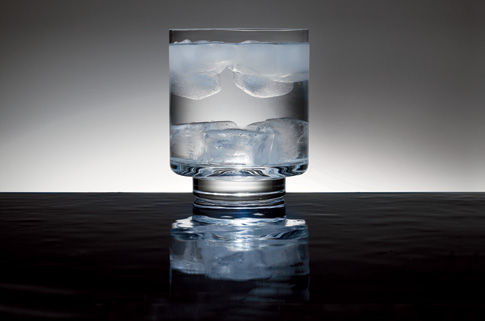
Want a surefire bet for your next cocktail party? First, tell your guests that aquatic life—at least in temperate climates—depends largely on the fact that ice floats. If it sank, lakes would freeze solid instead of forming an insulating layer of ice on top, killing all the fish. Now bet that you can magically make an ice cube sink. Grab one from a glass of special cubes you've strategically placed nearby, and drop it into a cup of ordinary water. Collect your guests' money.
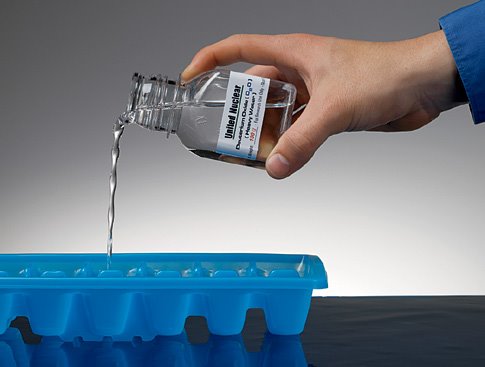
The key to the trick is heavy ice. Many terms shouldn't be taken literally—a red quark isn't red, a peanut is neither a pea nor a nut—but heavy water is exactly what it sounds like: water that weighs more than normal. This is possible because elements occur in several different forms, or isotopes, made up of atoms with the same number of protons and electrons (which determine their chemical properties) but a variable number of neutrons (which contribute weight but not much else).
Hydrogen atoms always have one proton and one electron, but only one in every 6,400 has a neutron that nearly doubles the atom¹s mass. Using a complex process called H2S, it¹s possible to isolate this heavy hydrogen, also known as deuterium (D), creating water that¹s about 10 percent heavier than normal.
Chemically, D2O—as it's written—is real water. Algae can grow and thrive in pure heavy water. Specially raised mice have contained as much as 25 percent heavy hydrogen; beyond that level, subtle biochemical reactions make the heavy mice sick. (Researchers used mice because they are small. Raising a heavy cow would be expensive.)
Heavy water's primary use is in nuclear reactors, but it is not itself radioactive. It's safe to handle (although drinking it is not recommended, so keep it out of your guests' glasses) and easy to buy from your neighborhood isotope supplier (try unitednuclear.com). For about $15 a cube, you can make your own sinking ice and win that bet every time—unless you're entertaining nuclear scientists.
Find more on Gray's experiments at periodictabletable.com and at popsci.com/graymatter
 Plane delivers super help
Via:Tallahassee
The Tallahassee Regional Airport runway was the site of a demonstration Thursday of the latest in aviation fire fighting tools: a 747 supertanker.
The converted 747 cargo plane dropped 205,000 gallons of water, while flying 180 mph at an altitude of 500 feet.
The plane flies higher and faster than conventional fire fighting planes -- and delivers the water volume of seven conventional planes.
The supertanker is made by an Oregon firm, which is in negotiations with the U.S. Forest Service to sell or lease the supertankers.

Awesome Color Scanning LEGO music machine
Via:[Jroller]
Last year Kristien bought me a package of Lego Mindstorms on ebay. The thing that gets me excited about Mindstorms is that it allows me, software guy, to write code that isn't restricted to the pc. The first thing I built is a (ta-daaam) Lego Music Machine. The idea is simple: the machine functions more or less like a scanner, except that in stead of creating an image from the scanned information, sound is generated. Here's a demo:
http://www.youtube.com/v/hYwdyu48bbI


Freezing water at room temperature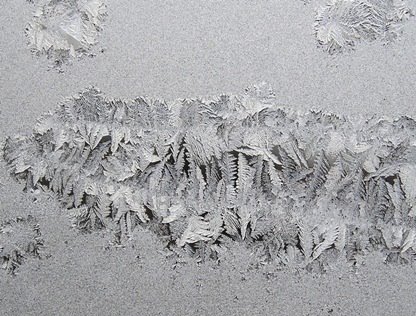
This is pretty weird. It turns out that water can freeze at room temperature in response to atomic-scale friction.Joost Frenken and others at Leiden University used an instrument called a friction force microscope to create nano-friction by dragging a tungsten wire over a graphite surface. They wanted to test the theory that water vapour in the air might condense and become ice. And it did.They were even able to draw frozen patterns on the graphite surface. They think that "icy nanoscale water bridges" form as water vapour condenses in the nanoscopic gaps between the two surfaces.So far, so strange. But the researchers say the discovery could also have practical uses. This is because the tiny frozen bridges turn water from a lubricant into a kind of glue. So the effect could be important in the future for building nanoscale devices or structures. Curiously, there are other ways to turn water to ice at room temperature, such as using electric fields.


